
Direct Mail vs Digital Marketing: Which Works Best for UK Businesses?
Direct mail and digital marketing both provide businesses with powerful ways to reach customers, generate enquiries and build stronger relationships.
But which works best?
The answer is not simply direct mail or digital marketing.
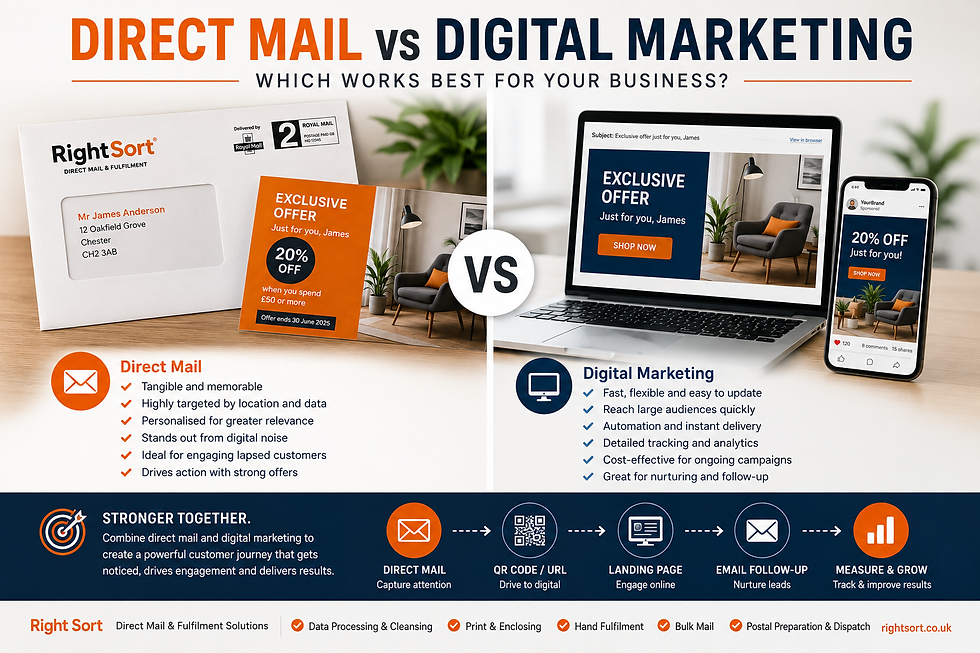
Direct mail provides physical visibility, targeted communication and a tangible customer experience. Digital marketing provides speed, reach, automation and detailed online tracking.
For many UK businesses, the strongest marketing strategy is therefore not choosing between direct mail and digital marketing, but understanding where each performs best and how they can work together.
What Is the Difference Between Direct Mail and Digital Marketing?
The main difference between direct mail and digital marketing is how the communication reaches the customer.
Direct mail marketing uses physical materials delivered directly to customers or prospects.
This can include:
Letters
Postcards
Brochures
Catalogues
Promotional packs
Customer communications
Personalised offers
Digital marketing reaches customers through online channels.
These can include:
Email marketing
Search engines
Social media
Online advertising
Websites
Content marketing
Remarketing
Video
Both approaches can be highly targeted and measurable when campaigns are planned correctly.
The difference is the experience they create for the customer.
Is Direct Mail Better Than Digital Marketing?
Direct mail is not automatically better than digital marketing, and digital marketing is not automatically better than direct mail.
The right channel depends on:
The target audience
The campaign objective
The product or service
Customer behaviour
Available data
Campaign budget
Required response
Timing
Direct mail may be particularly effective when businesses want to create physical visibility or communicate directly with a carefully selected audience.
Digital marketing may be more appropriate when speed, large-scale reach or immediate online interaction is required.
The strongest campaigns often use both.
What Are the Advantages of Direct Mail Marketing?
Direct mail provides several advantages that purely digital communication cannot replicate.
Direct Mail Is Physical
A direct mail piece exists physically within someone's home or workplace.
Recipients need to interact with it in some way, even if that simply means picking it up from the doormat.
A brochure, catalogue or postcard may also remain visible after it has initially been received.
Direct Mail Can Be Highly Targeted
Businesses can use customer and prospect data to target specific audiences.
Campaigns can potentially be segmented according to:
Postcode
Location
Customer type
Purchase history
Membership
Previous engagement
Customer value
Product interest
This allows businesses to focus mailing budgets on the audiences they most want to reach.
Direct Mail Can Be Personalised
Modern direct mail can be personalised using variable data.
Personalisation can include:
Customer names
Different offers
Location-specific information
Relevant products
Personalised images
Unique promotional codes
Individual QR codes
This allows businesses to create physical communication that feels considerably more relevant than generic mass mail.
Direct Mail Can Create Strong Brand Visibility
Print gives businesses opportunities to use:
Paper quality
Creative formats
Branded envelopes
Professional imagery
Different finishes
Bespoke inserts
The physical format becomes part of the marketing experience.
What Are the Advantages of Digital Marketing?
Digital marketing offers a different set of advantages.
Speed
Digital campaigns can often be launched and adjusted quickly.
Reach
Businesses can potentially reach large audiences through search engines, social media and online advertising.
Automation
Email campaigns and other digital communication can be automated according to customer behaviour.
Measurement
Businesses can track online activity such as:
Website visits
Clicks
Form submissions
Purchases
Bookings
Email engagement
Flexibility
Digital campaigns can often be changed quickly based on performance.
These advantages make digital marketing an important part of most modern marketing strategies.
Direct Mail vs Email Marketing: What's the Difference?
Email is one of the digital channels most commonly compared with direct mail.
Both allow businesses to communicate directly with customers, but the experience is very different.
Email provides:
Immediate delivery
Low distribution costs
Automation
Fast links to websites
Easy campaign testing
Direct mail provides:
Physical communication
Tangible brand interaction
Creative print opportunities
Geographical targeting
A different way to reach customers
Businesses do not necessarily need to choose between them.
An email and direct mail campaign can support each other as part of the same customer journey.
Is Direct Mail Still Effective in a Digital World?
Yes.
Digital marketing has changed how businesses communicate, but it has not removed the role of physical communication.
In fact, the amount of digital communication customers receive can create opportunities for well-targeted physical mail to stand apart.
The effectiveness of direct mail depends on factors including:
Data quality
Audience targeting
Personalisation
Campaign message
Creative execution
Offer
Timing
Fulfilment
Call to action
Direct mail should therefore be judged by the quality of the campaign rather than simply the channel itself.
Which Industries Can Benefit from Direct Mail?
Direct mail can be used across many sectors.
Charities
Charities can use direct mail for fundraising, supporter communications and donor engagement.
Financial and Professional Services
Physical communications can support detailed, professional and personalised customer messaging.
Property
Estate agents and property businesses can target specific streets, postcodes and geographical areas.
Retail and eCommerce
Retailers can use catalogues, offers, loyalty campaigns and customer reactivation mailings.
Leisure and Entertainment
Venues and attractions can promote events, memberships, experiences and seasonal offers.
Education
Schools, colleges and training providers can distribute prospectuses, course information and event invitations.
Membership Organisations
Associations and membership organisations can use physical communication for renewals, events and member updates.
When Is Digital Marketing the Better Choice?
Digital marketing can be particularly useful when a business needs:
Immediate communication
Rapid campaign changes
Large-scale reach
Online purchasing
Frequent customer updates
Automated communication
Search visibility
Social engagement
For example, a short-term online promotion may benefit from email, paid advertising and social media because customers can respond immediately.
When Is Direct Mail the Better Choice?
Direct mail can be particularly valuable when businesses want:
Physical brand presence
Geographical targeting
Personalised customer communication
Premium presentation
Customer reactivation
Detailed information packs
Targeted promotional campaigns
A communication that stands apart from digital activity
The choice should always be based on the audience and campaign objective.
Can Direct Mail and Digital Marketing Work Together?
Yes, and this is where businesses can create particularly strong campaigns.
Direct mail can provide the physical touchpoint while digital channels provide the next stage of the customer journey.
For example, a personalised direct mail piece could contain a QR code that takes the recipient to a dedicated landing page.
The journey becomes:
Direct Mail → QR Code → Landing Page → Enquiry or Purchase
Another campaign might work like this:
Email → Direct Mail → Sales Follow-Up → Website
Or:
Social Advertising → Direct Mail → Online Offer → Remarketing
The individual channels support each other rather than operating separately.
How Can QR Codes Connect Direct Mail and Digital Marketing?
QR codes provide a simple bridge between physical and digital marketing.
A recipient can scan a code using their smartphone and move immediately from a printed communication to an online destination.
This could include:
A website
Landing page
Product page
Booking system
Ecommerce store
Video
Online offer
Contact form
QR codes can also be unique to individual campaigns or customers, making responses easier to measure.
How Can Businesses Personalise Integrated Campaigns?
Customer data can help businesses personalise both physical and digital communications.
For example, a customer who previously purchased a particular product could receive:
A personalised direct mail offer
A unique QR code
A dedicated online landing page
Relevant follow-up email communication
The messaging remains consistent across the customer journey.
This creates a more connected experience than treating each marketing channel independently.
How Do You Measure Direct Mail Against Digital Marketing?
Digital marketing is often associated with measurement, but direct mail can also be tracked.
Businesses can use:
QR codes
Promotional codes
Dedicated landing pages
Unique URLs
Dedicated telephone numbers
Customer reference numbers
This allows direct mail responses to be connected to:
Website visits
Enquiries
Bookings
Purchases
Registrations
Revenue
Businesses can then compare campaign costs with the commercial results generated.
Which Has the Better Return on Investment?
There is no universal answer.
Return on investment depends on:
Audience
Campaign cost
Product value
Customer lifetime value
Response rate
Conversion rate
Campaign objective
A relatively small direct mail campaign targeting high-value prospects could potentially generate greater commercial value than a digital campaign reaching thousands of less relevant people.
Equally, a digital campaign may provide a more efficient solution for a low-cost product requiring large-scale reach.
The important metric is not simply how many people saw the campaign.
It is what commercially valuable action those people took afterwards.
Why Data Matters Across Both Channels
Whether businesses use direct mail or digital marketing, data quality remains critical.
Poor customer data can result in:
Incorrect targeting
Duplicate communications
Irrelevant offers
Wasted advertising spend
Wasted print
Wasted postage
Data processing and cleansing helps businesses improve the information used to build campaigns.
Better data supports better targeting across both physical and digital marketing.
How Can Businesses Reduce Direct Mail Costs?
Direct mail can involve higher distribution costs than some digital channels, which makes efficiency particularly important.
Businesses can control costs through:
Accurate data
Duplicate removal
Appropriate mail formats
Efficient print production
Bulk mailing
Postal preparation
Suitable Royal Mail services
Campaign segmentation
The objective should not necessarily be to create the cheapest campaign.
It should be to reduce waste while maximising the commercial value of the audience being targeted.
Why Fulfilment Matters in Direct Mail Marketing
Unlike digital marketing, physical campaigns require production and fulfilment.
This can involve:
Data preparation
Printing
Envelope printing
Folding
Enclosing
Hand fulfilment
Addressing
Postal sorting
Dispatch
Professional fulfilment helps ensure the right communication reaches the right recipient accurately and on time.
The operational quality of a direct mail campaign is therefore just as important as the marketing idea behind it.
Frequently Asked Questions About Direct Mail vs Digital Marketing
Is direct mail better than digital marketing?
Neither is automatically better. Direct mail provides physical, targeted communication, while digital marketing offers speed, reach and automation. The right choice depends on the audience and campaign objective.
Is direct mail still effective?
Yes. Direct mail can remain effective when campaigns use accurate data, relevant targeting, strong creative and a clear call to action.
Is direct mail better than email?
Direct mail and email provide different customer experiences. Email offers speed and automation, while direct mail provides physical interaction. Businesses can use both within the same campaign.
Can direct mail be tracked?
Yes. QR codes, promotional codes, dedicated landing pages, unique URLs and telephone numbers can help businesses measure direct mail responses.
Can direct mail and digital marketing work together?
Yes. Physical mail can direct customers to websites, landing pages, ecommerce stores and online booking systems, allowing physical and digital marketing to form one customer journey.
What businesses benefit from direct mail?
Direct mail can be particularly useful for charities, retailers, ecommerce businesses, professional services, property companies, education providers, leisure businesses and membership organisations.
Direct Mail or Digital Marketing: Which Should Your Business Choose?
The real question is not whether direct mail or digital marketing is better.
It is which combination gives your business the best opportunity to reach the right audience and generate the desired response.
Digital marketing provides speed, automation and online reach.
Direct mail provides physical visibility, personalisation and a tangible customer experience.
Used strategically, they can complement each other.
Businesses can use data to identify the right audience, direct mail to create the physical interaction and digital marketing to continue the customer journey and measure the response.
Right Sort supports UK businesses with professional direct mail campaigns, including data processing and cleansing, envelope printing, print and enclosing, hand fulfilment, bulk mailing, postal preparation and dispatch.


Comments