
Why Personalised Direct Mail Campaigns Generate Better Response Rates
Updated: Aug 23
Personalised direct mail can help businesses create more relevant, targeted and engaging communications by tailoring the message to the individual receiving it.
Instead of sending exactly the same letter, offer or brochure to everyone, businesses can use customer data to personalise names, locations, offers, products, imagery and messaging.
For UK businesses competing for customer attention, this can turn a standard direct mail campaign into a communication that feels much more relevant to the recipient.
But why does personalised direct mail work, and how can businesses use it effectively?

What Is Personalised Direct Mail?
Personalised direct mail is physical marketing that uses customer or prospect data to tailor some or all of the communication to an individual recipient or audience segment.
Personalisation can include:
Customer names
Addresses
Locations
Previous purchases
Relevant products
Customer-specific offers
Membership information
Unique promotional codes
Personalised URLs
QR codes
Different images or messaging
Rather than treating an entire mailing database as one audience, personalised direct mail allows businesses to communicate differently with different customers.
Why Does Personalised Direct Mail Work?
Personalised direct mail works because relevance matters.
People are more likely to pay attention to communication that appears to have been created specifically for them or relates directly to their circumstances.
Consider the difference between receiving:
“Dear Customer, take a look at our latest offers.”
and:
“Hello John, here’s an exclusive offer based on your recent purchase.”
The second communication immediately provides more context and relevance.
Effective personalisation can help a campaign feel less like mass marketing and more like direct communication between the business and its customer.
Does Personalised Direct Mail Increase Response Rates?
Personalisation can improve the likelihood of engagement when it is based on accurate data and a relevant offer.
Simply adding someone's first name does not automatically make a campaign successful.
The strongest personalised direct mail campaigns combine:
Accurate customer data
Intelligent segmentation
Relevant messaging
Appropriate offers
Professional presentation
A clear call to action
Personalisation should therefore support the campaign strategy rather than simply being added as a decorative feature.
How Can Direct Mail Be Personalised?
There are several levels of direct mail personalisation.
Personalised Names and Addresses
The simplest form uses the recipient's name and address throughout the communication.
This might include:
Personalised envelope addressing
Named letters
Customer references
Personalised greetings
Even basic personalisation can make communication feel more intentional.
Personalised Offers
Businesses can provide different offers depending on the customer.
For example, an ecommerce retailer might send one offer to existing customers and another to customers who have not purchased for several months.
Location-Based Personalisation
Businesses operating across different geographical areas can adapt campaigns according to location.
This could include:
Nearest branch
Local representative
Local event
Regional service
Area-specific promotion
This can be particularly useful for businesses with local branches, service areas or regional campaigns.
Purchase-Based Personalisation
Previous purchasing behaviour can be used to make future communications more relevant.
Businesses could promote:
Complementary products
Replacement products
Renewals
Upgrades
Repeat purchases
Related services
This turns existing customer information into more useful marketing communication.
Personalised Imagery and Creative
Variable data printing can allow different recipients or customer groups to receive different creative elements.
This could include:
Different photographs
Different headlines
Product-specific imagery
Regional creative
Customer-specific offers
The physical mail piece can therefore change depending on who receives it.
What Is Variable Data Printing?
Variable data printing allows elements of printed material to change automatically from one recipient to another.
Instead of printing thousands of completely identical pieces, businesses can use data to vary specific elements during production.
These could include:
Names
Addresses
Headlines
Images
Offers
Promotional codes
Customer references
QR codes
Variable data printing makes larger personalised direct mail campaigns much more practical.
Why Is Customer Data Important for Personalised Direct Mail?
Personalisation is only as good as the data behind it.
Incorrect information can quickly turn a personalised campaign into a negative customer experience.
Common data problems include:
Incorrect names
Old addresses
Duplicate records
Missing information
Inconsistent formatting
Outdated customer details
Imagine receiving a supposedly personalised letter addressed incorrectly or containing an offer that has no relevance to you.
Instead of strengthening the customer relationship, poor personalisation can have the opposite effect.
This is why data processing and cleansing should take place before personalised mail enters production.
What Is Data Cleansing for Direct Mail?
Data cleansing is the process of reviewing, correcting and organising mailing data before it is used within a campaign.
This can include:
Removing duplicate records
Identifying incomplete information
Standardising address formats
Correcting inconsistencies
Organising customer records
Preparing data for personalisation
Segmenting audiences
Cleaner data improves both campaign accuracy and operational efficiency.
It can also reduce wasted print and postage by removing records that should not be included.
What Is Direct Mail Segmentation?
Segmentation involves dividing a larger customer database into smaller groups based on shared characteristics.
Businesses might segment customers according to:
Location
Customer type
Purchase history
Product interest
Membership status
Previous engagement
Customer value
Length of relationship
Each group can then receive communication designed specifically for them.
This can be considerably more relevant than sending one generic message to the entire database.
Personalised Direct Mail for Existing Customers
Existing customers can be particularly suitable for personalised direct mail because businesses may already have useful information about their relationship.
Campaigns could include:
Customer loyalty offers
Renewal reminders
Product recommendations
Anniversary communications
Exclusive promotions
Reactivation campaigns
Thank-you communications
The objective is to use existing customer information to create a more relevant reason to engage again.
Personalised Direct Mail for Customer Reactivation
Many businesses hold databases containing customers who have not purchased or engaged for some time.
Personalised direct mail can provide another way to reconnect with these customers.
A reactivation campaign might include:
A personalised welcome-back message
An exclusive returning-customer offer
Relevant product recommendations
A time-sensitive promotion
An invitation to reconnect
Physical mail can provide a different customer touchpoint when emails are no longer being opened or acted upon.
Personalised Direct Mail for Charities and Membership Organisations
Personalisation can also be valuable for charities, associations and membership organisations.
Communications can potentially reflect:
Previous donations
Membership status
Renewal dates
Events attended
Areas of interest
Length of membership
This can help organisations create communications that recognise the existing relationship rather than treating every recipient identically.
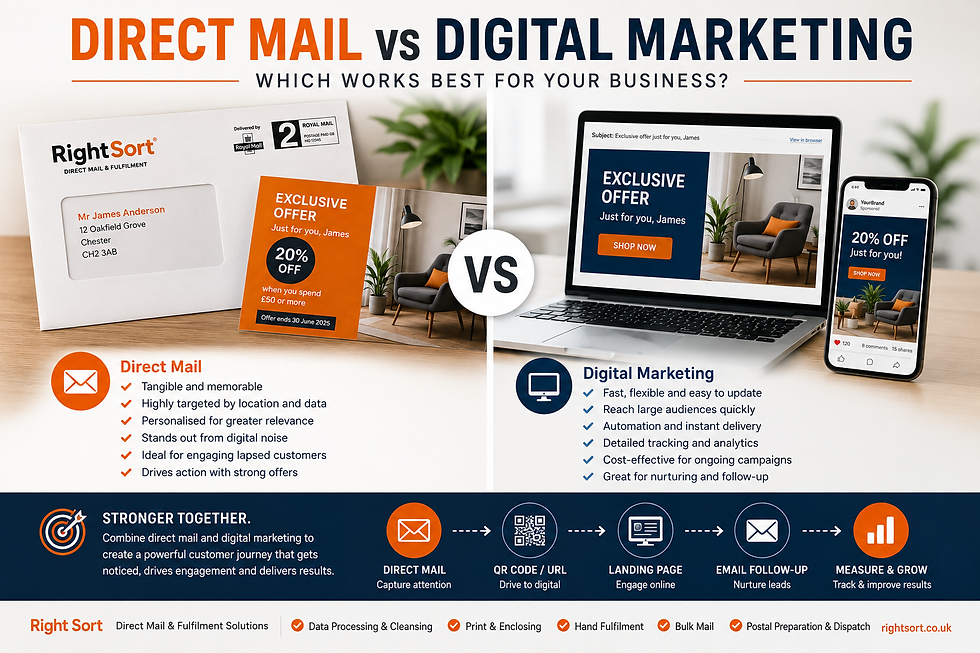
Can Personalised Direct Mail Work With Digital Marketing?
Yes.
Personalised direct mail becomes particularly powerful when physical and digital communication work together.
A personalised mailing could include:
Unique QR codes
Personalised URLs
Individual offer codes
Online booking links
Customer-specific landing pages
The recipient moves from the physical mail piece into a digital journey designed around the campaign.
Businesses can then measure the response and continue communication through other channels.
How Can Personalised Direct Mail Be Measured?
Personalised campaigns can include individual tracking mechanisms.
These can include:
Unique QR codes
Promotional codes
Personalised URLs
Customer reference numbers
Dedicated landing pages
Unique booking links
Businesses can then measure:
Website visits
Enquiries
Purchases
Bookings
Registrations
Offer redemptions
Revenue generated
This allows businesses to understand not only whether the campaign generated responses, but potentially which customer groups responded.
Why Does the Direct Mail Offer Matter?
Personalisation alone is not enough.
The recipient still needs a reason to take action.
A personalised campaign should combine relevance with an appropriate offer or proposition.
Depending on the business, this could include:
Exclusive discounts
Early access
Loyalty rewards
Free consultations
Product recommendations
Event invitations
Membership benefits
Personalised quotations
The strongest offer is one that makes sense for the person receiving it.
Why Presentation Still Matters
Personalised content still needs professional presentation.
Print quality, envelope choice, design and fulfilment all influence how the campaign is perceived.
Businesses should consider:
Print quality
Envelope printing
Paper stock
Layout
Branding
Inserts
Packaging
Overall presentation
Personalisation should feel integrated into the campaign rather than added as an afterthought.
How Does Fulfilment Work for Personalised Direct Mail?
Personalised campaigns require accurate fulfilment.
The correct communication must reach the correct recipient.
Depending on the campaign, fulfilment can involve:
Data preparation
Variable printing
Document matching
Folding
Enclosing
Hand fulfilment
Addressing
Postal sorting
Dispatch
Quality control becomes particularly important when different customers are receiving different versions of a campaign.
Common Personalised Direct Mail Mistakes
Businesses should avoid several common mistakes when planning personalised campaigns.
These include:
Using inaccurate customer data
Personalising only the customer's name
Sending irrelevant offers
Overcomplicating the message
Using outdated customer information
Poor database segmentation
Having no measurable call to action
Failing to check personalised output
Ignoring data protection responsibilities
Effective personalisation should make communication more relevant, not more complicated.
Is Personalised Direct Mail Suitable for Small Businesses?
Yes.
Personalised direct mail does not have to involve hundreds of thousands of items.
Smaller, highly targeted campaigns can be particularly effective because businesses can concentrate their budget on a carefully selected audience.
For example, a business might send a personalised campaign to:
High-value customers
Previous customers
Local prospects
Membership lists
Selected businesses
Customers approaching renewal
The quality and relevance of the audience can be more important than the overall mailing volume.
Frequently Asked Questions About Personalised Direct Mail
What is personalised direct mail?
Personalised direct mail uses customer or prospect data to tailor physical marketing communications to an individual recipient or audience segment.
Does personalised direct mail work?
Personalised direct mail can improve campaign relevance and engagement when accurate customer data, appropriate targeting and relevant messaging are used together.
What can be personalised in direct mail?
Names, addresses, offers, headlines, images, promotional codes, QR codes and other elements can potentially be personalised.
What is variable data printing?
Variable data printing allows specific elements of printed material to change automatically between recipients using information from a database.
Why is data cleansing important for personalised mail?
Incorrect or outdated data can result in inaccurate personalisation, wasted mail and poor customer experiences. Data cleansing helps improve accuracy before production.
Can personalised direct mail be tracked?
Yes. Unique QR codes, promotional codes, personalised URLs and dedicated landing pages can help businesses measure campaign responses.
Can direct mail be personalised at scale?
Yes. Variable data printing and professional fulfilment systems allow businesses to produce personalised campaigns across larger mailing volumes.
Creating More Relevant Direct Mail Campaigns
The purpose of personalisation is not simply to prove that a business knows a customer's name.
It is to make the communication more relevant.
The strongest personalised direct mail campaigns use accurate data to understand who the recipient is, what may interest them and what action the business wants them to take next.
When data, segmentation, creative, print and fulfilment work together, personalised direct mail can create a far more targeted customer experience than generic mass communication.
Right Sort supports UK businesses with personalised direct mail campaigns, including data processing and cleansing, variable print preparation, envelope printing, print and enclosing, hand fulfilment, bulk mailing and postal dispatch.


Comments