
Direct Mail vs Email Marketing: Why Direct Mail Still Works for UK Businesses
Is direct mail marketing still effective in 2026? Yes. For many UK businesses, direct mail remains an effective way to reach customers, generate enquiries, build brand awareness and support wider marketing campaigns.
Email marketing is fast, inexpensive and easy to automate. It is also competing for attention in inboxes overflowing with promotions, newsletters, notifications and sales messages.
Direct mail marketing works differently.
A professionally produced letter, brochure, postcard or mailing pack puts something physical directly into the hands of the person a business wants to reach.
That does not mean direct mail is always better than email marketing. Both have an important place in a modern marketing strategy. However, for certain audiences, industries and campaigns, direct mail offers advantages that digital communication cannot easily replicate.

What Is Direct Mail Marketing?
Direct mail marketing is the process of sending physical marketing materials directly to customers or prospective customers, usually through the postal system.
Direct mail campaigns can include:
Marketing letters
Postcards
Flyers
Brochures
Catalogues
Promotional packs
Personalised offers
Customer communications
Modern direct mail campaigns can also combine customer data, personalisation and digital technology such as QR codes and campaign-specific landing pages.
This allows businesses to combine the physical impact of direct mail with the measurement and convenience of digital marketing.
Is Direct Mail Marketing Still Effective?
Yes. Direct mail remains relevant because it provides businesses with a physical way to reach their target audience.
An email may be one of hundreds of messages competing for attention in someone's inbox.
Direct mail arrives separately and requires the recipient to physically interact with it.
That creates a different type of customer touchpoint.
Direct mail can be particularly effective when businesses want to:
Reach a clearly defined target audience
Target customers by geographical area
Re-engage previous customers
Communicate important information
Promote high-value products or services
Create personalised marketing campaigns
Support existing digital marketing activity
The key to successful direct mail is targeting. Sending relevant communications to carefully selected audiences is considerably different from simply distributing untargeted mail.
Direct Mail vs Email Marketing: What's the Difference?
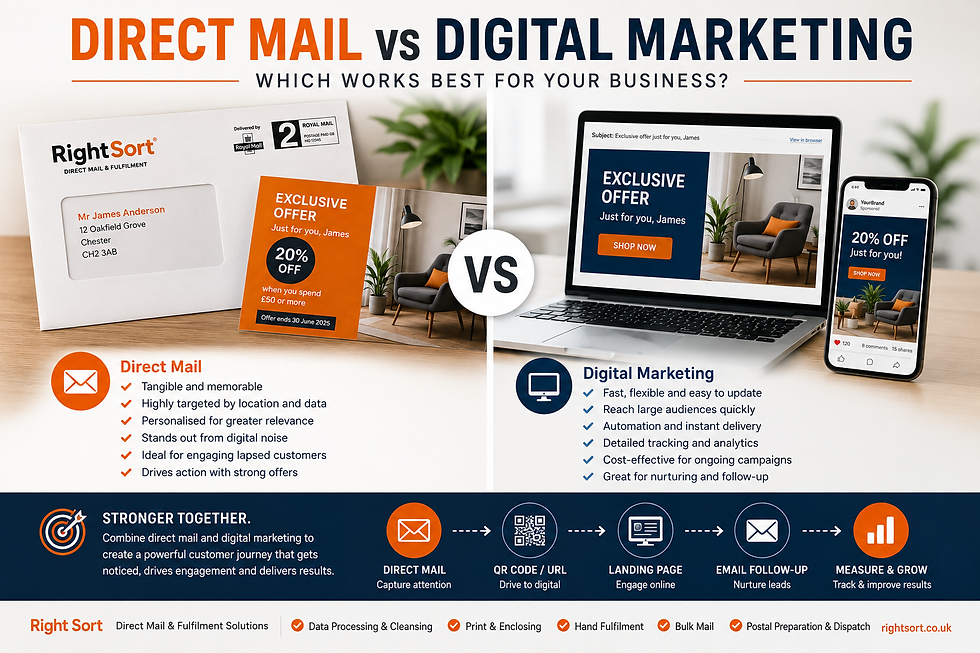
The biggest difference between direct mail and email marketing is how the customer experiences the communication.
What Are the Advantages of Email Marketing?
Email marketing is particularly useful for:
Regular customer communication
Automated campaigns
Newsletters
Customer updates
Short-term promotions
Driving immediate website traffic
Email is fast, flexible and relatively inexpensive to distribute.
However, businesses are competing against crowded inboxes, spam filters and large volumes of other marketing communication.
What Are the Advantages of Direct Mail Marketing?
Direct mail creates a physical interaction with the recipient.
Businesses can send:
Personalised letters
Postcards
Brochures
Catalogues
Promotional materials
Customer information packs
Physical marketing materials can remain in a home or workplace after they have been received, giving the recipient an opportunity to return to the communication later.
For the right audience and campaign, this physical presence can make direct mail particularly valuable.
Is Direct Mail Better Than Email Marketing?
Neither channel is automatically better.
Email works extremely well when businesses require fast, regular and automated communication.
Direct mail can be particularly effective when a business wants to create greater physical visibility, reach a defined geographical audience or deliver a communication that feels more personal and tangible.
For many businesses, the strongest strategy is to use direct mail and email together rather than choosing between them.
Which Industries Benefit Most from Direct Mail Marketing?
Direct mail can be used across almost any industry, but there are several UK sectors where physical customer communication remains particularly valuable.
Direct Mail for Charities
Charities can use direct mail for fundraising, supporter communications, campaign awareness and donor engagement.
Physical communication provides space to tell stories, explain how donations make a difference and provide supporters with clear ways to respond.
Direct Mail for Financial and Professional Services
Trust and credibility are particularly important within financial and professional services.
Letters, information packs and personalised communications allow organisations to provide detailed information in a professional format.
Direct mail can also create an additional customer touchpoint alongside sales, email and digital marketing activity.
Direct Mail for Property and Estate Agents
Direct mail allows estate agents and property businesses to target very specific geographical areas.
Campaigns can focus on:
Individual postcodes
Specific streets
Housing developments
Local communities
Previous customers
This makes direct mail particularly useful for businesses whose customers are strongly connected to location.
Direct Mail for Retail and eCommerce
Retail and ecommerce businesses can use direct mail alongside online marketing to encourage repeat purchases and customer reactivation.
Campaigns can include:
Product catalogues
Discount vouchers
Customer reactivation campaigns
New product launches
Seasonal promotions
Loyalty offers
The physical campaign can then direct customers back to the company's website or ecommerce store.
Direct Mail for Leisure and Entertainment
Venues, attractions and entertainment businesses can use direct mail to promote:
Events
Memberships
Seasonal activities
New attractions
Special offers
Visually engaging printed materials can work particularly well when promoting experiences that benefit from strong imagery and creative presentation.
Direct Mail for Education and Membership Organisations
Schools, colleges, training providers, associations and membership organisations regularly need to communicate detailed information.
Direct mail can support:
Membership renewals
Course information
Prospectuses
Event invitations
Important customer communications
Physical communication provides organisations with more space to explain detailed information than many digital advertising formats.
How Does Personalised Direct Mail Work?
Personalised direct mail uses customer data to tailor elements of a campaign to individual recipients or audience segments.
Personalisation can include:
Customer names
Locations
Previous purchases
Customer types
Membership information
Relevant offers
Campaign-specific messaging
Modern direct mail personalisation can go much further than simply adding someone's name to a letter.
Different customer segments can receive different offers, messages, imagery or inserts according to the purpose of the campaign.
This makes communication more relevant to the person receiving it.
Why Is Data Cleansing Important for Direct Mail?
Successful direct mail starts with accurate data.
Sending professionally designed marketing materials to incorrect, duplicated or outdated addresses wastes print, fulfilment and postage.
Data processing and cleansing can help businesses identify these problems before a campaign enters production.
This can include:
Removing duplicate records
Checking address information
Correcting formatting
Organising mailing data
Preparing databases for production
Segmenting customer audiences
Cleaner data can reduce unnecessary waste while helping businesses target their campaigns more accurately.
Can Direct Mail and Digital Marketing Work Together?
Yes. Direct mail and digital marketing can form part of the same customer journey.
For example, a direct mail campaign can encourage someone to:
Visit a dedicated landing page
Scan a QR code
Claim an online offer
Book an appointment
Submit an enquiry
Visit an ecommerce store
Follow a social media account
Digital marketing can then support the campaign through email, social media, online advertising or follow-up communication.
Rather than asking whether direct mail or digital marketing is better, businesses should consider how both channels can work together.
How Can You Measure Direct Mail Marketing?
Direct mail campaigns can be designed with specific response mechanisms that help businesses measure performance.
These can include:
Unique QR codes
Promotional codes
Campaign-specific website addresses
Dedicated landing pages
Unique telephone numbers
Individual offer codes
Businesses can then measure responses such as enquiries, website visits, bookings or sales.
Campaign measurement also helps businesses understand which audiences, offers and messages perform best.
What Does a Direct Mail Fulfilment Company Do?
A direct mail fulfilment company manages some or all of the operational work required to prepare and dispatch a mailing campaign.
Depending on the campaign, this can include:
Data processing and cleansing
Envelope printing
Print and enclosing
Hand fulfilment and manual mailings
Bulk mail campaign preparation
Postal sorting
Royal Mail preparation
Dispatch
Using an experienced direct mail provider can help businesses manage larger campaigns efficiently while reducing the administrative workload placed on internal teams.
How Can Businesses Reduce the Cost of Direct Mail?
Direct mail costs depend on factors including campaign volume, format, print requirements, fulfilment and postage.
Businesses can potentially improve cost efficiency by:
Cleaning mailing data before production
Removing duplicate records
Selecting appropriate mailing formats
Consolidating campaign production
Using bulk mail services
Preparing mail correctly for postal discounts
Using services such as Royal Mail Sort & Save where appropriate
For larger campaigns, careful planning before printing can make a significant difference to overall campaign costs.
Frequently Asked Questions About Direct Mail Marketing
What is direct mail marketing?
Direct mail marketing involves sending physical marketing communications such as letters, postcards, brochures and promotional packs directly to customers or prospects.
Does direct mail still work in the UK?
Yes. Direct mail continues to be used by UK businesses, charities and organisations as part of customer acquisition, retention, communication and integrated marketing campaigns.
Is direct mail better than email?
It depends on the audience and objective. Email provides speed and automation, while direct mail provides a physical customer touchpoint. Many campaigns can benefit from using both.
Can direct mail be personalised?
Yes. Customer data can be used to personalise names, offers, messaging and other elements of a direct mail campaign.
Can direct mail campaigns be measured?
Yes. QR codes, promotional codes, dedicated landing pages, campaign URLs and telephone numbers can all help businesses measure responses.
Can a mailing company handle the entire campaign?
Yes. A full-service direct mail provider can manage data preparation, printing, enclosing, fulfilment, postal preparation and dispatch, depending on the requirements of the campaign.
Direct Mail Marketing for UK Businesses
Direct mail has not disappeared because marketing became digital. Its role has evolved.
Businesses now have better customer data, more sophisticated personalisation and more ways to connect physical campaigns with online activity.
The question is therefore no longer simply, "Does direct mail still work?"
The more useful question is whether direct mail is right for the audience, objective and campaign.
When those elements align, direct mail can provide businesses with a powerful additional way to reach customers, generate engagement and support wider sales and marketing activity.
Right Sort provides professional direct mail services for businesses across the UK, supporting campaigns with data processing and cleansing, envelope printing, print and enclosing, hand fulfilment, bulk mailing, postal preparation and dispatch.


Comments