
What Makes a Successful Direct Mail Campaign?
A successful direct mail campaign starts with much more than a good design and a mailing list.
The strongest campaigns combine accurate data, clear targeting, relevant messaging, professional print, reliable fulfilment and a measurable call to action.
For UK businesses, direct mail can provide a powerful way to reach customers and prospects physically, particularly when it forms part of a wider sales and marketing strategy.
So, what makes a direct mail campaign successful?
It comes down to reaching the right people, with the right message, at the right time and making it easy for them to respond.

What Is a Direct Mail Campaign?
A direct mail campaign is a targeted marketing campaign that sends physical communications directly to customers or prospective customers.
Direct mail can include:
Letters
Postcards
Flyers
Brochures
Catalogues
Promotional offers
Membership packs
Customer communications
Product samples
Bespoke mailing packs
Unlike general leaflet distribution, direct mail campaigns are typically built around customer or prospect data, allowing businesses to target specific audiences and personalise communications.
What Are the Key Elements of a Successful Direct Mail Campaign?
A successful direct mail campaign normally depends on seven core elements:
A clearly defined objective
The right target audience
Accurate and clean data
Relevant and personalised messaging
Strong design and presentation
Professional print and fulfilment
A clear and measurable call to action
Each element contributes to the overall performance of the campaign.
A strong creative concept sent to poor-quality data is unlikely to perform well. Equally, an accurate database will not compensate for an offer that gives the recipient no reason to respond.
Successful direct mail brings all of these elements together.
Start With a Clear Campaign Objective
Before designing anything, businesses should decide exactly what the direct mail campaign needs to achieve.
Possible objectives include:
Generating enquiries
Increasing sales
Re-engaging previous customers
Promoting a new product
Driving website traffic
Increasing event attendance
Generating donations
Encouraging membership renewals
Booking appointments
Building brand awareness
Having one clear objective makes it easier to determine the audience, message, format and call to action.
Who Should You Target With Direct Mail?
Audience targeting is one of the most important factors in direct mail campaign performance.
Sending more mail does not automatically generate better results.
Businesses should identify the customers or prospects most likely to be interested in the communication.
Audiences can potentially be segmented according to:
Location
Postcode
Customer type
Previous purchases
Interests
Membership status
Previous engagement
Customer value
Product or service requirements
Better targeting helps businesses reduce unnecessary mail while making communications more relevant.
Why Is Data Important in a Direct Mail Campaign?
Accurate data is the foundation of effective direct mail.
Incorrect addresses, duplicate records and outdated information create unnecessary costs before the campaign has even reached the recipient.
Poor data can lead to:
Returned mail
Duplicate communications
Wasted print
Wasted postage
Incorrect personalisation
Poor customer experience
Data processing and cleansing before production can help identify and remove these problems.
This can include address checking, duplicate removal, database formatting and segmentation.
Cleaner data means businesses can concentrate their campaign budget on the people they actually want to reach.
Does Personalisation Improve Direct Mail Campaigns?
Personalisation can make direct mail more relevant to the recipient.
Modern personalised direct mail can go far beyond adding a customer's name to a letter.
Campaigns can potentially be personalised using:
Customer names
Location
Previous purchases
Relevant products
Membership information
Personalised offers
Unique discount codes
Different campaign messages
Different customer groups can receive different versions of the same campaign.
The aim is to make the communication feel relevant rather than mass-produced.
What Should a Direct Mail Message Include?
Direct mail should communicate its main message quickly.
Recipients should be able to understand:
Who the communication is from
Why they have received it
What is being offered
Why it is relevant
What they should do next
Trying to communicate too many messages within one campaign can reduce its effectiveness.
A strong direct mail campaign usually focuses on one central proposition supported by a clear call to action.
Why Is the Offer Important?
The recipient needs a reason to respond.
An offer does not necessarily have to be a discount.
Depending on the campaign, it could include:
A free consultation
An exclusive product
Early access
Event registration
A free trial
A membership benefit
A limited-time promotion
Additional information
A personalised quotation
The offer should be relevant to both the audience and the campaign objective.
What Makes a Strong Direct Mail Call to Action?
A call to action tells the recipient exactly what to do next.
Examples include:
Visit our website
Scan the QR code
Call today
Request a quotation
Book an appointment
Claim your offer
Register for the event
Use your promotional code
Visit a dedicated landing page
The easier it is to respond, the more useful the campaign becomes.
Where possible, businesses should also make the call to action measurable.
How Can Direct Mail Campaigns Be Measured?
Direct mail can be tracked using specific response mechanisms.
These can include:
QR codes
Unique promotional codes
Dedicated landing pages
Campaign-specific URLs
Dedicated telephone numbers
Unique booking links
Customer reference codes
These tools allow businesses to measure actions generated by the campaign.
Businesses can then analyse:
Enquiries
Website visits
Sales
Bookings
Redemptions
Registrations
Revenue generated
Measurement helps businesses understand campaign performance and improve future direct mail activity.
Why Does Direct Mail Design Matter?
Design needs to capture attention while making the message easy to understand.
Good direct mail design should support the campaign rather than overpower it.
Important considerations include:
Clear branding
Readable typography
Strong imagery
Logical information hierarchy
Clear offer
Visible call to action
Appropriate mailing format
The physical format should also be considered during the design process because size, weight and packaging can affect production and postage costs.
Why Professional Printing Matters
Print quality directly influences how a campaign feels when it reaches the recipient.
A professionally produced piece of direct mail can reinforce:
Brand quality
Credibility
Trust
Attention to detail
The appropriate print specification will depend on the campaign.
A premium customer pack may require a very different approach from a large-volume customer communication.
The important point is that print quality should reflect the business, audience and objective.
What Role Does Envelope Printing Play?
The envelope is often the first part of a direct mail campaign the recipient sees.
Professional envelope printing can help:
Reinforce branding
Improve recognition
Create curiosity
Provide campaign consistency
Make communications appear more professional
For some campaigns, a simple envelope may be most appropriate. For others, branded or personalised envelope printing can become part of the creative strategy.
Why Direct Mail Fulfilment Matters
Once the campaign has been designed and printed, it still needs to be prepared accurately for dispatch.
Direct mail fulfilment can involve:
Data processing
Printing
Folding
Enclosing
Hand fulfilment
Addressing
Sorting
Postal preparation
Dispatch
Errors at the fulfilment stage can undermine everything that came before.
Accurate fulfilment helps ensure the correct communication reaches the correct recipient in the intended format.
Automated or Hand Fulfilment?
The right fulfilment method depends on the campaign.
Automated print and enclosing can be highly efficient for larger campaigns involving consistent formats.
Hand fulfilment and manual mailing may be more appropriate when campaigns contain:
Multiple inserts
Unusual formats
Samples
Premium packs
Bespoke combinations
Delicate materials
Choosing the right process helps businesses balance cost, speed and presentation.
How Can Businesses Reduce Direct Mail Postage Costs?
Postage can represent a significant part of a large direct mail campaign.
Businesses can improve cost efficiency by considering postage requirements before production begins.
This can include:
Cleaning mailing data
Removing duplicates
Choosing suitable mail formats
Consolidating mailing volumes
Preparing data correctly
Using bulk mailing services
Sorting mail appropriately
Selecting suitable Royal Mail services
Planning production and postage together can prevent unnecessary costs later in the campaign.
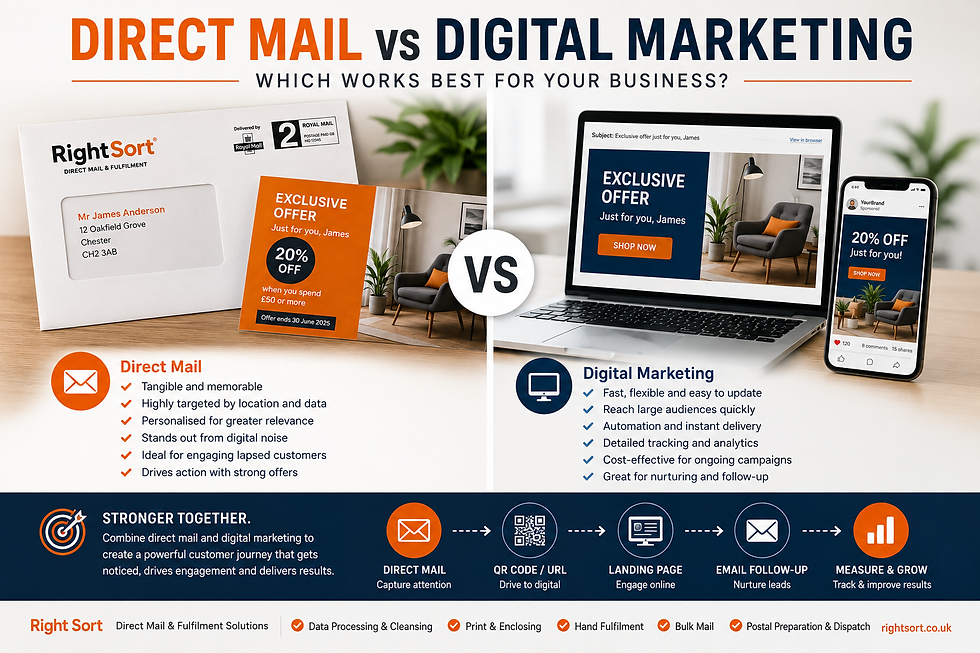
Can Direct Mail Work With Digital Marketing?
Yes. Direct mail can work extremely effectively alongside digital channels.
A physical mailing can direct recipients towards:
Websites
Landing pages
Ecommerce stores
Online booking systems
Social media
Digital offers
Businesses can then continue the conversation through email, sales follow-up, remarketing or social media.
This creates a connected customer journey rather than treating direct mail as an isolated marketing channel.
When Is the Best Time to Send a Direct Mail Campaign?
The best timing depends on the audience and objective.
Businesses should consider:
Seasonal demand
Customer buying cycles
Events
Renewal dates
Product launches
Promotional periods
Sales follow-up activity
Timing can also affect fulfilment requirements.
Planning campaigns early provides more opportunity to optimise data, production, postage and delivery.
Common Direct Mail Campaign Mistakes to Avoid
Some of the most common mistakes include:
Using poor-quality mailing data
Targeting too broad an audience
Having no clear campaign objective
Using generic messaging
Hiding the call to action
Failing to measure responses
Leaving postage planning until the end
Poor-quality print or presentation
Failing to test different approaches
Avoiding these mistakes can significantly improve campaign efficiency.
Frequently Asked Questions About Direct Mail Campaigns
What makes a good direct mail campaign?
A good direct mail campaign combines a clear objective, accurate customer data, relevant targeting, strong messaging, professional production and an easy-to-understand call to action.
Is direct mail still effective for UK businesses?
Yes. Direct mail continues to provide businesses with a physical way to reach targeted customers and can work particularly well when integrated with digital marketing and sales activity.
How do you measure a direct mail campaign?
Businesses can use QR codes, promotional codes, dedicated landing pages, telephone numbers and unique URLs to track responses generated by direct mail.
Should direct mail be personalised?
Personalisation can improve relevance by adapting names, messaging, offers or content according to the recipient or customer segment.
How much does a direct mail campaign cost?
The cost depends on factors including volume, data preparation, print specification, format, fulfilment and postage. Each campaign should therefore be planned according to its individual requirements.
Can a mailing company manage the entire direct mail campaign?
A professional direct mail provider can support data processing, printing, envelope printing, enclosing, hand fulfilment, bulk mail preparation, postal sorting and dispatch.
Building a Better Direct Mail Campaign
A successful direct mail campaign is not created by one element alone.
Data, targeting, creative, personalisation, print, fulfilment, postage and measurement all need to work together.
The strongest campaigns begin with a clear objective and build every stage around the audience the business wants to reach.
When properly planned, direct mail provides businesses with a tangible, targeted and measurable way to communicate with customers.
Right Sort supports UK businesses with professional direct mail campaign services, including data processing and cleansing, envelope printing, print and enclosing, hand fulfilment, bulk mail preparation and postal dispatch.


Comments